

Scratch makes learning to code simple, creative and accessible for beginners without requiring complicated programming languages or long lines of text. Developed by the MIT Media Lab, Scratch uses colourful visual coding blocks that users can connect to create programs and see the results instantly. It is designed for students, teachers, families and anyone who wants to explore programming through hands-on creative projects.
As a Beginner Coding Platform, Scratch allows users to create interactive stories, games, animations and simulations by arranging coding blocks like pieces of a puzzle. This visual approach makes important programming concepts such as sequences, events, loops, conditions and variables easier to understand, making Scratch a practical starting point for anyone beginning their coding journey. Visit Homepage
What Is Scratch and Who Is It For?
Beginner Coding Platform is a free block-based programming platform created by the MIT Media Lab. Instead of requiring users to remember programming syntax, it provides visual blocks that can be dragged into the coding workspace and joined together.
The platform is particularly useful in education because learners can experiment with programming while creating something they can actually see and interact with. A beginner might start with a character that moves across the screen, then gradually add dialogue, sounds, scores, levels or other interactive features.
Beginner Coding Platform can be useful for:
The main idea is simple: learn programming by making projects rather than memorising large amounts of code.
Why Scratch Is Useful for Learning Programming
Traditional programming can be difficult for beginners because a small spelling or syntax error may prevent a program from working. Beginner Coding Platform reduces this barrier by using blocks that are designed to fit together according to programming rules.
This makes it easier to focus on the logic behind a program. For example, learners can understand that an action needs a trigger, that repeated instructions can be placed inside a loop, and that a condition can determine what happens next.
Visual Blocks Make Coding Easier
The Beginner Coding Platform editor groups blocks according to their functions. Different categories handle movement, appearance, sounds, events, control structures, sensing, calculations and data.
Because each block has a specific purpose, beginners can experiment without first learning complicated syntax.
Creative Projects Keep Learners Engaged
A major advantage of Beginner Coding Platform is that coding is connected to creative work. Instead of solving abstract exercises only, a learner can create a character, design a scene and programme how that character behaves.
This project-based approach can make programming concepts easier to remember because users immediately see the effect of their instructions.
Sharing Encourages Learning
Beginner Coding Platform also provides a community environment where projects can be viewed and remixed. Looking at another creator’s project can help beginners understand how different blocks work together.
Remixing also gives learners an opportunity to change an existing idea and turn it into something of their own while maintaining credit for the original creator.
Scratch Features Beginners Should Know
Before creating a first project, it helps to understand the main features available in the platform.
| Feature | What It Does | Useful For |
|---|---|---|
| Visual coding | Uses connected programming blocks | Learning programming logic |
| Sprites | Provides characters and objects | Games and animations |
| Backdrops | Adds scenes to the Stage | Stories and visual projects |
| Costumes | Changes a sprite’s appearance | Animation and character design |
| Sounds | Adds audio and effects | Interactive projects |
| Variables | Stores changing information | Scores, timers and game states |
| Community | Allows projects to be shared | Learning and collaboration |
| Offline editor | Supports project creation without an active connection | Learning away from the web |
These tools can be introduced gradually. A beginner does not need to understand every feature before starting.
How to Create a Scratch Account
You can experiment with the platform without immediately creating an account, but a free account provides additional options for saving projects online, sharing creations and participating in the Beginner Coding Platform community.
The registration process is straightforward.
Step 1: Open Scratch
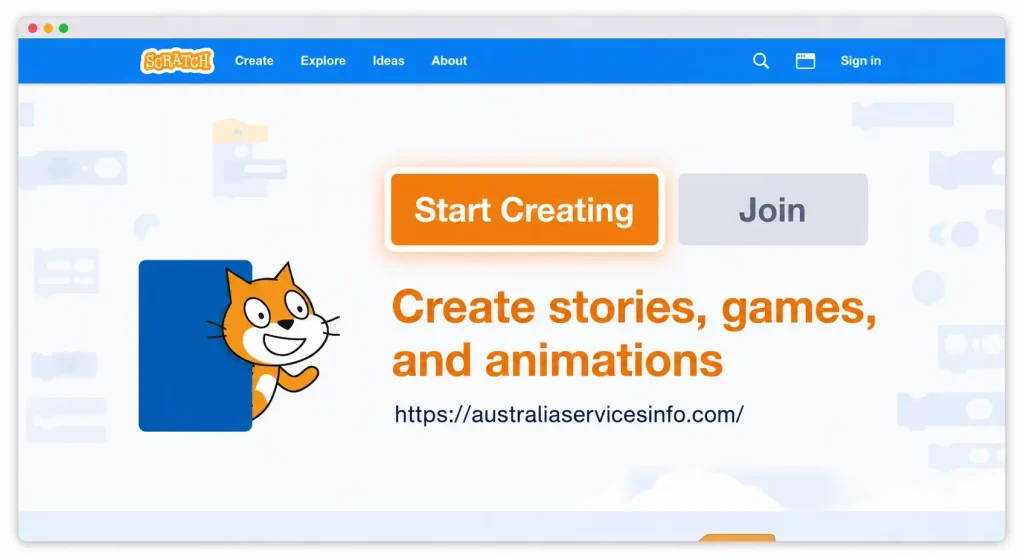
Start by opening the official Kids Coding and Animation Platform website in a browser. From the homepage, look for the option to join the Beginner Coding Platform community and begin the account creation process.
Step 2: Choose a Username and Password

Create a username that does not reveal your real name or other unnecessary personal information. Then set a strong password that is difficult for other people to guess.
Your username becomes part of your Kids Coding and Animation Platform identity, so choosing something appropriate is useful if you plan to share projects publicly.
Step 3: Enter the Requested Information
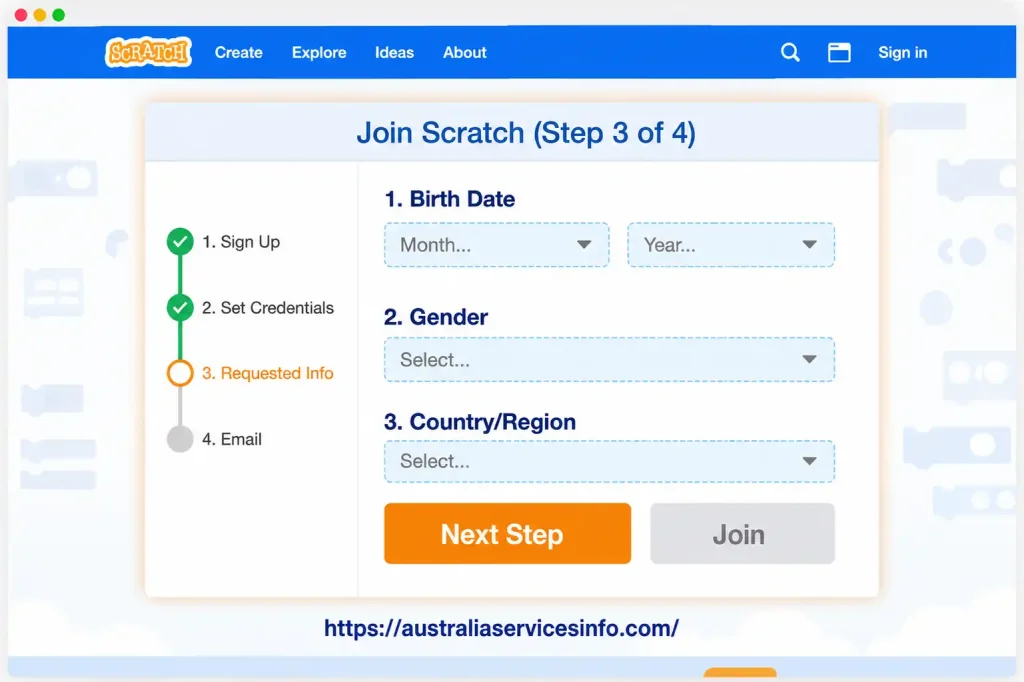
Beginner Coding Platform asks for some basic information during account creation, including details such as country of residence and birth information. Follow the instructions displayed on the registration screen and provide accurate information where required.
The information is used for platform and demographic purposes rather than as part of the programming process.
Step 4: Verify the Email Address
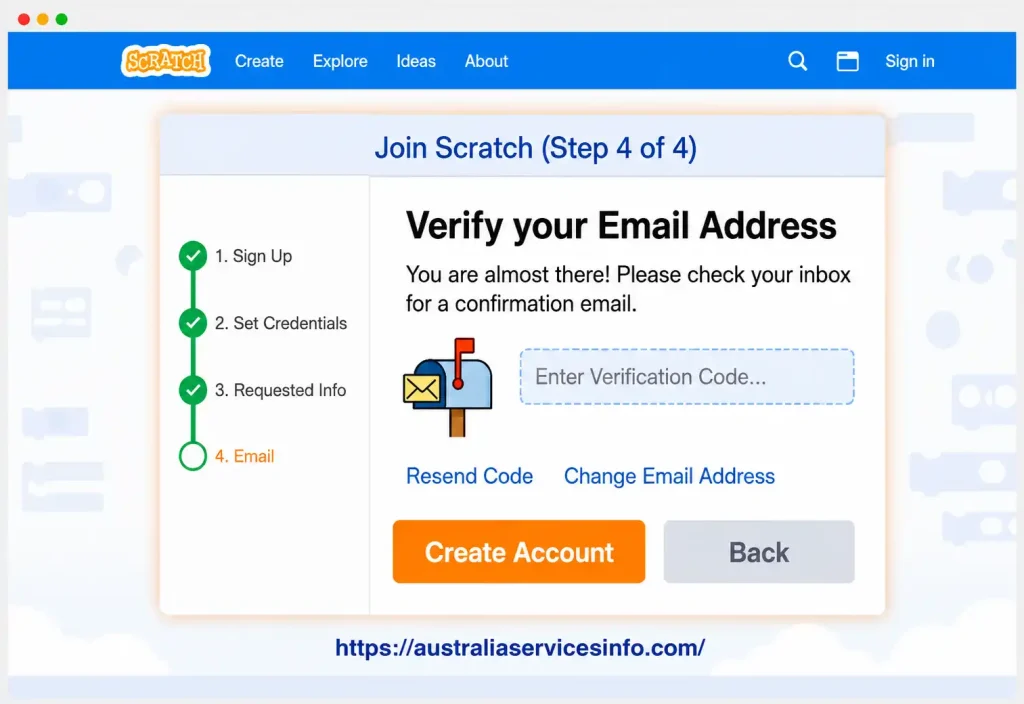
An email address is used to complete account verification. Check the relevant inbox for the verification message and follow its instructions.
Email confirmation is important if you want to use features connected with sharing and community participation.
Safety Tip: Young users should follow the platform’s safety guidance and, where appropriate, involve a parent, guardian or teacher when creating and using an online account.
Understanding the Scratch Editor
Once you open the project editor, the interface may appear busy at first. In practice, it is divided into several areas, and each area has a clear job.
The main workspace includes the block palette, coding area, Stage and sprite/backdrop controls.
Block Palette
The block palette contains the programming instructions you can use in a project. Blocks are grouped into categories so that related commands are easier to find.
Common categories include:
You do not need to memorise these categories. As you build projects, their purposes become familiar naturally.
Coding Area
The coding area is where blocks are placed and connected. This is effectively the programming workspace.
For example, an event block can be placed first, followed by a movement instruction and then a speech instruction. When the appropriate event occurs, the connected blocks run according to their order.
Stage
The Stage is where the project appears and runs. Sprites move, speak and interact here.
It acts as the visual output of your programme, allowing you to test whether your instructions are producing the expected result.
Sprite and Backdrop Controls
The sprite area lets you manage the characters and objects used in a project. You can add new sprites, remove unwanted ones and select the sprite whose behaviour you want to programme.
Backdrops control the visual environment behind the sprites. Changing the backdrop can help establish the setting for a story, game or animation.
How Scratch Code Works
Beginner Coding Platform programmes are built by connecting blocks into scripts. The blocks can represent actions, triggers, decisions and repeated behaviour.
A simple project might work like this:
Event → Movement → Speech → Sound
When the starting event occurs, the character moves, says something and then produces an audio effect.
More advanced projects can use conditions and loops. For example, a game might repeatedly check whether a player has touched an object. If the condition is true, the programme could increase a score or trigger another action.
This is where Beginner Coding Platform becomes more than a drawing or animation tool. It introduces genuine programming ideas through a visual interface.
Your First Scratch Animation
A first project does not need to be complicated. Start with one character, one backdrop and a few connected blocks.
Step 1: Start a New Project
Open the Beginner Coding Platform editor and create a new project. A default character is normally available on the Stage, giving you something to programme immediately.
Step 2: Select a Backdrop
Choose a backdrop that matches the scene you want to create. For a simple animation, a plain or colourful background is enough.
Step 3: Add a Starting Event
Find the event that begins a script when the green flag is selected. Place it in the coding area.
This gives your project a clear starting point.
Step 4: Make the Character Move
Add a Motion block below the event. When the project starts, the character will perform the movement instruction.
You can experiment with the number of steps to see how the character’s position changes.
Step 5: Add Dialogue
Add a Looks block that makes the character display a short message. This creates a basic sequence in which the character moves and then speaks.
Step 6: Run the Animation
Start the project using the green flag above the Stage. Watch the character perform the instructions in the order you created.
If something does not happen as expected, return to the coding area and check that the blocks are connected correctly.
A Good Way to Practise Scratch
The fastest way to become comfortable with Beginner Coding Platform is to make small projects rather than attempting a large game immediately.
Try creating projects in stages:
- A character that moves
- A character that speaks
- A short animated scene
- A project with user interaction
- A simple game with a score
- A larger project combining several ideas
Each stage introduces another programming concept without making the learning process overwhelming.
Building Better Scratch Projects
Once you understand the basic editor, the next step is learning how different Beginner Coding Platform features work together. This is where small experiments can become interactive stories, games and more structured animations.
Working With Sprites and Costumes
A sprite is an object or character that can be programmed inside a project. The Beginner Coding Platform library provides ready-made options, but you can also customise characters to suit your idea.
Add and Manage Sprites
A project can contain more than one sprite. For example, a simple game could have a player, an opponent and an object that the player needs to collect.
Each sprite can have its own scripts. Selecting the correct sprite before adding blocks is therefore important because the instructions you create apply to the selected object.
Use Costumes for Animation
Costumes allow a sprite to change its appearance. Switching between costumes can create the impression that a character is walking, talking or performing another action.
A basic animation can therefore combine movement with costume changes. When these instructions are placed inside a suitable sequence or loop, the result can look much more natural than a stationary character.
Using Events to Control Projects
Events are among the most important ideas in Scratch because they determine when a script should begin.
A project can respond to different actions or situations. For instance, a script might start when the green flag is clicked, while another behaviour can begin after a particular interaction.
Why Events Matter
Without a trigger, a sequence of blocks has no clear reason to start. Events connect user actions and project conditions with the instructions that should follow.
This concept is closely related to event-driven programming used in more advanced programming environments.
Loops and Repeated Actions
Repeating instructions is common in games and animations. Instead of placing the same command many times, Beginner Coding Platform provides control blocks that can repeat an instruction or group of instructions.
Repeat a Fixed Number of Times
A repeat loop is useful when you know how many times an action should occur.
For example, a character could move a certain distance several times. The loop keeps the script shorter and makes the intended behaviour easier to change later.
Use Forever for Continuous Behaviour
A forever loop is useful when something needs to keep happening while the project is running.
Games often use continuous checks for movement, interaction or other conditions. However, beginners should use forever loops carefully because an incorrectly designed loop can make a project behave in unexpected ways.
Conditions and Decisions
A programme often needs to make decisions. Beginner Coding Platform supports this through conditional control blocks.
A simple example is:
If something happens → perform an action.
A game could check whether a character has touched a particular object. If the condition is true, the project could respond by changing the score, playing a sound or moving the character.
Why Conditions Are Important
Conditions teach an important programming principle: software does not always follow one fixed path.
Instead, the result can depend on what happens during execution. This makes conditional blocks especially useful for games and interactive stories.
Variables for Scores and Game Information
Variables allow Beginner Coding Platform projects to store information that can change while a project runs.
A game score is a common example. The score might start at zero and increase whenever a player collects an object.
Variables can also be useful for:
Creating a Simple Score System
A basic scoring system can be built by creating a score variable, setting its starting value and changing it when the required event occurs.
For example, when a player collects an item, the project can increase the score. The displayed value then gives the player immediate feedback.
This is a useful exercise because it introduces the idea of storing and changing data inside a programme.
Making Projects Interactive
Interaction is what turns a basic animation into something a user can control.
Beginner Coding Platform can respond to actions such as clicking, touching or other sensing conditions. Combining sensing with events, control blocks and variables can produce surprisingly detailed projects.
Interactive Story Example
Imagine a story with two characters. One character can speak after an event, while another responds afterwards. Changing costumes and backdrops can move the story from one scene to another.
The project can be developed gradually rather than being built all at once.
Simple Game Example
A beginner game could ask the player to move a character and collect objects. Each successful collection could increase a variable, while touching an unwanted object might trigger a different response.
This type of project introduces several programming concepts at once while still being manageable for a beginner.
Adding Sound to a Project
Sound can make an animation or game feel more responsive. Scratch provides tools for adding audio and controlling how sounds are used.
You can use sound for:
The best approach is to use audio where it supports the project rather than adding sounds simply because they are available.
Saving and Managing Your Work
Saving becomes especially important once a project contains a large amount of code or artwork.
When using a Beginner Coding Platform account, projects can be saved online, making it easier to return to previous work. The editor also provides a way to save the current project manually.
Save Before Making Major Changes
A useful habit is to make sure your current work has been saved before experimenting with a large change.
This is particularly helpful when working on school assignments or longer projects where losing progress could mean rebuilding several scripts.
Sharing a Scratch Project
After developing a project, users can make it available to the Beginner Coding Platform community.
Before sharing, check the project carefully. Test the controls, remove unnecessary information and make sure the title and project description explain what visitors are supposed to do.
What to Check Before Sharing
Use this short checklist:
Sharing should be treated as the final stage of a project rather than something done before testing.
How Remixing Works
One of the distinctive learning features of Beginner Coding Platform is remixing. A user can open another creator’s project and use the remix function to create a modified version.
The purpose is not simply to copy a project. Remixing can be used as a practical way to study how another person built an idea.
A Useful Remixing Method
Instead of changing everything immediately, begin by identifying one part of the original project that interests you.
For example, you might examine:
Then make one controlled modification and observe what happens.
This approach turns an existing project into a practical programming lesson.
Scratch Offline Editing
Scratch also provides an offline editor for supported desktop environments, including Windows, macOS and ChromeOS.
An offline option can be useful when a reliable internet connection is unavailable. It allows learners to continue developing projects without depending on an active online session.
The online platform remains useful for community features and sharing, while offline editing is mainly suited to creating and working on projects locally.
Common Beginner Mistakes
Learning programming involves experimentation, so mistakes are normal. Knowing the most common problems can save time.
Blocks Are Not Connected
If a script does nothing, first check whether the blocks are properly attached. A disconnected block will not necessarily execute as part of the intended sequence.
The Wrong Sprite Is Selected
A common beginner error is adding instructions to a different sprite from the one they intended to control.
Always check which sprite is active before creating or changing its scripts.
Too Many Blocks Are Added at Once
Large scripts can become difficult to understand. Build a feature in small sections and test each part before adding another layer.
Loops Run Unexpectedly
A forever loop can continue running throughout the project. If a script produces unwanted behaviour, inspect its loops and conditions to determine whether an instruction is repeating more often than intended.
Projects Are Not Tested Frequently
Waiting until the end to test a project can make debugging difficult.
A better habit is to test after adding each major feature. If something stops working, you then have a much smaller area to investigate.
Tips for Students Learning Scratch
Students can get more from Scratch by treating each project as a programming exercise rather than only a finished product.
Start Small
A short project with a clear goal is often more useful than a large unfinished game.
Begin with one mechanic, understand how it works and then add another feature.
Change One Thing at a Time
When experimenting, avoid changing many scripts simultaneously. If several things change and the project stops working, it becomes harder to identify the cause.
Read Other Projects Carefully
Community projects can provide useful examples of different programming techniques. Instead of only looking at the final animation, examine how the creator organised the scripts.
Keep Testing
Programming improves through trial and error. If a block produces an unexpected result, change the script, run it again and compare the outcome.
That process is part of learning rather than a sign that you have failed.
Tips for Teachers Using Scratch
Beginner Coding Platform can also support classroom activities because students can demonstrate concepts through projects.
Teachers can use projects to introduce:
A useful classroom approach is to give learners a clear objective without prescribing every block they must use. This allows students to find their own solutions and compare different approaches.
Scratch Project Ideas for Beginners
If you are unsure what to create next, choose a project with one clear purpose.
Animated Greeting
Create a character that enters the Stage, moves to a position and displays a message.
Interactive Story
Build a short story using multiple characters, dialogue and changing scenes.
Collection Game
Create a game in which the player controls a character and collects objects to increase a score.
Catching Game
Programme one object to move while the player attempts to control another character and catch it.
Quiz Project
Create questions that respond to user input and use variables to keep track of results.
These projects can be expanded gradually as your programming skills improve.
How to Make a Scratch Project Better
A good project should be easy to understand and enjoyable to use. Before adding more features, test the project from the user’s point of view.
Check whether the character responds correctly, instructions are clear, sounds work properly and the project behaves as expected from beginning to end.
Organise Your Scripts
As a project becomes larger, a sprite may contain several scripts. Keeping related instructions together makes the project easier to understand and edit.
For example, movement, dialogue and interaction can be handled through separate scripts when that makes the project clearer.
Use Clear Variable Names
Variables are useful for information that changes while a project is running. Names such as score, timer, or lives make their purpose obvious.
Clear names become particularly valuable when a game contains several variables.
Debugging Scratch Projects
Sometimes a project does not behave as expected. This is a normal part of learning to programme.
Start by running the project and identifying exactly where the problem occurs. Then check the relevant sprite and its scripts instead of changing many parts at once.
A Simple Debugging Method
- Run the project and reproduce the problem.
- Identify the sprite responsible for the behaviour.
- Check the event that starts the script.
- Examine the blocks and their order.
- Check loops and conditions.
- Change one part and test again.
Testing after each major change makes problems much easier to locate.
Using Scratch for Games
Scratch can be used to create many types of simple games. A beginner project might involve controlling a character, collecting objects and increasing a score.
As your skills improve, you can add different levels, timers, obstacles, sounds and additional characters.
Creating a Score System
A score can be stored in a variable. When the player successfully completes an action, the variable can increase.
For example, collecting an object could add points to the player’s score. This gives immediate feedback and introduces an important programming concept: changing stored data while a programme is running.
Adding Game Conditions
Conditions allow the game to react differently depending on what happens.
A project could check whether a player has touched an object. If the condition is true, the game might increase the score, play a sound or move the object to another position.
Creating Interactive Stories
Scratch is also useful for storytelling. Characters can speak, move and respond to events while backdrops can represent different scenes.
A simple story might begin with one character speaking, followed by another character responding. A backdrop can then change when the story moves to a new location.
This type of project helps learners practise events, sequences, costumes, sounds and timing.
Using Scratch in Education
Teachers can use Beginner Coding Platform to introduce programming concepts through practical projects. Students can demonstrate what they have learned by creating games, animations, stories or simulations.
Projects can introduce:
The creative nature of Scratch also allows programming activities to connect with other subjects.
For example, students can create an animated explanation of a science concept or build an interactive project around a mathematical idea.
Saving and Sharing Scratch Projects
When you are satisfied with a project, save your work so you can return to it later. Users with a Scratch account can save projects online and use community features.
Before sharing a project, test it carefully and make sure its instructions are understandable.
What to Check Before Sharing
Make sure:
Sharing should come after testing rather than before it.
Remixing Scratch Projects
Remixing allows users to build on another creator’s project. Instead of starting from an empty workspace, you can examine an existing project and modify its code.
This can be a useful learning method.
For example, you might study how another project handles movement, scoring or interaction and then change one part to see how the behaviour changes.
The original creator should receive credit when their project is remixed.
Scratch Offline Editor
The Scratch offline editor allows supported users to work on projects without an active internet connection. It is available for desktop environments including Windows, macOS and ChromeOS.
Offline editing can be useful when internet access is unavailable. Online features remain useful when you want to share projects or participate in the Scratch community.
Common Scratch Problems
A Script Does Not Start
Check whether the correct event block is connected to the script. Also make sure you are testing the correct sprite.
The Wrong Character Moves
Select the sprite you intended to programme and check its scripts. Instructions belong to the selected sprite, so selecting the wrong object can produce unexpected behaviour.
A Character Repeats an Action
Look for repeat or forever blocks. A loop may be causing the instruction to run continuously.
The Score Does Not Change
Check the variable and the block responsible for changing it. Make sure the condition that should increase the score is actually being triggered.
The Project Behaves Differently Than Expected
Test the project one section at a time. Examine events, conditions and loops to find which instruction is producing the unexpected result.
Scratch Learning Tips for Beginners
The most effective way to learn Scratch is through regular practice.
Start with a small project instead of trying to create a complicated game immediately. Once one feature works, add another.
Experiment with different blocks and observe the results. If something does not work, change it and test again. This process helps you understand programming logic naturally.
Studying existing projects can also help. Look at how creators organise their scripts and try to understand why particular blocks are connected.
Frequently Asked Questions About Scratch
Final Thoughts
Scratch gives beginners a practical way to learn programming by creating things they can see and control. Its block-based approach makes concepts such as events, loops, conditions and variables easier to explore.
Start with a small project, test each feature and gradually introduce more advanced ideas. Whether the goal is a game, animation, interactive story or classroom project, consistent practice is the best way to become more confident with Scratch.
READ MORE
Blooket (2026): Complete Guide to Games, Login, Hosting, Joining & Learning
Smartraveller (2026): Complete Guide to Travel Advice, Safety Alerts & Australian Consular Support