

OnGuard v3 is an online Work Health and Safety (WHS) training and assessment platform used by Australian schools and educational organisations. It gives students access to safety information and assessments that may be required before they take part in practical subjects involving workshops, laboratories, machinery, tools, or other equipment.
The platform is designed to help students understand safe working practices before they enter practical learning environments. Through assigned modules and competency assessments, students can demonstrate their understanding of hazards, safety procedures, equipment use, and risk management.onguarf v3 brings training content, assessments, progress information, and completion records together in one digital system. Teachers can use the platform to keep track of student progress, while students may be able to access their assigned training from school or home.
For practical subjects where students may work with equipment that requires safety knowledge, completing the required OnGuard v3 training can form an important part of preparation before hands-on activities begin. Visit Homepage
Why Schools Use OnGuard v3
Schools can use onguarf v3 to provide students with a consistent approach to safety education and to maintain records of completed training and competency assessments. Digital delivery can make it easier to manage safety instruction than relying only on printed handbooks or classroom explanations.
The platform can also help schools provide common safety information across different classes and year groups. Depending on the training assigned, students may learn about hazards, workshop practices, equipment operation, emergency procedures, and risk awareness.
Another useful feature for schools is digital progress tracking. Teachers can check whether students have completed the required modules and assessments, which can assist with confirming training requirements before practical activities.
Common reasons schools use onguarf v3 include:
Who Uses OnGuard v3?
onguarf v3 is mainly used within educational settings, with different users having different responsibilities on the platform.
Students
Students generally use onguarf v3 to access the training assigned to them. This may involve reading safety information, working through learning modules, completing assessments, and demonstrating their knowledge of safe work practices before taking part in practical activities.
Teachers
Teachers can use the platform to manage student training requirements. Their tasks may include assigning modules, checking completion progress, reviewing assessment outcomes, and confirming that students have met the required training requirements.
School Administrators
School administrators may be involved in setting up and managing the platform within the school. Depending on the school’s system, they may oversee accounts, coordinate training requirements, and support the school’s broader safety and compliance processes.
Technical and Support Staff
Technical or IT support staff may help users who experience access problems. Their assistance can include account-related support, password or credential issues, and other technical problems affecting access to the platform.
Key Benefits of OnGuard v3
OnGuard v3 can make safety training easier to organise by bringing learning materials, assessments, and progress information into a digital environment.
Improved Safety Awareness
Students can learn about relevant safety procedures before entering a workshop or using equipment. Early exposure to hazards and safe operating practices can help students understand what is expected of them during practical lessons.
Consistent Training Standards
Digital training allows schools to provide the same core safety information to students across different classes and departments. This can support a more consistent approach to safety education.
Flexible Learning Access
Where school arrangements allow it, students may be able to access unfinished training outside normal classroom hours. This gives them additional flexibility when working through assigned material.
Digital Record Keeping
Training and assessment information can be recorded electronically. For teachers and schools, this can make it easier to review student progress and identify whether required training has been completed.
Interactive Learning Experience
OnGuard v3 provides safety information in a digital format rather than relying entirely on printed resources. Interactive learning materials can help students engage with safety topics and reinforce important concepts.
Understanding the OnGuard v3 Login Process
Getting into an onguarf v3 account is generally straightforward when the student has the correct details supplied by their school.
Before trying to log in, students should make sure they have received their User ID and passphrase from the appropriate teacher, training coordinator, or school administrator. These details may be provided when a student begins a course or practical subject that requires safety training.
Schools may also provide their own instructions for accessing the platform. It is worth following those instructions carefully because the login process or account details can vary between institutions.
Information You May Need Before Logging In
Students may need several pieces of information before they can access their account:
Preparing these details before opening the login page can make the sign-in process smoother and reduce the chance of entering incorrect information.
Step-by-Step Guide to Access Your OnGuard v3 Account
Step 1: Open the OnGuard v3 Portal
Start by opening a web browser and visiting the onguarf v3 login portal supplied by your school.
Make sure you are using the correct portal before entering your account details. Using the school-provided access information is the best way to ensure you are connecting to the intended training environment.
Step 2: Search for Your School
Once the login page loads, look for the section used to identify your school.
Students are generally asked to enter their suburb first. The system may then display matching schools in a selection list.
Check the options carefully and select the school that you attend. Selecting a different institution can result in the account details not being recognised.
Step 3: Enter Your User ID
After choosing your school, enter the User ID provided by your teacher or school administrator.
The format of a User ID can differ between schools because institutions may use their own account naming conventions. Always use the exact User ID supplied to you rather than trying to create or guess one.
Step 4: Enter Your Passphrase
Enter the assigned passphrase in the relevant password field.
Take care when typing it because login credentials may be case-sensitive. Check for common mistakes such as missing characters, incorrect capital letters, or accidental spaces before trying again.
Step 5: Access Your Dashboard
After the login details have been successfully verified, you should be taken to your onguarf v3 dashboard.
This area provides access to the training and assessments assigned to your account. Depending on your school’s setup, you may also be able to view your progress and see which safety modules still need to be completed.
First-Time Login Setup in OnGuard v3
The first time students sign in to onguarf v3, they may need to complete a few account security steps before accessing their assigned training. These initial checks help protect student accounts and keep training and assessment information accessible only to authorised users.
The setup process is usually completed once. Students should follow the instructions shown on screen and use the account details supplied by their school.
Changing Your Initial Passphrase
After the first successful sign-in, students may be asked to replace their original passphrase with a new one. The new passphrase should be secure while still being easy for the student to remember.
When choosing a new passphrase, consider the following:
Using a strong passphrase adds protection to your onguarf v3 account and helps prevent other people from accessing your training records.
Setting a Security Question
During the initial account setup, some students may also be asked to create a security question.
This can provide another way to verify the account if recovery is needed later. Choose a question with an answer that you will remember easily, while avoiding information that classmates or other people could readily guess.
Reviewing Account Information
Before starting your assigned safety training, check the account information displayed on screen.
Make sure the details appear correct and match the information provided by your school. If something is incorrect or you cannot access the appropriate training, speak with your teacher or school administrator rather than attempting to change account details yourself.
Understanding the OnGuard v3 Dashboard
Once you have successfully logged in, onguarf v3 takes you to your personal dashboard.
The dashboard is the main area for managing your assigned safety training. It can show the modules you need to work through, assessment requirements, progress information, and completed training, depending on how your school has configured the platform.
You may see items such as:
Checking the dashboard regularly makes it easier to see what has already been completed and identify any requirements that are still outstanding.
Assigned Learning Modules
The assigned modules area shows the safety training linked to your subjects or practical activities.
The modules given to one student may not be identical to those assigned to another. Training requirements can depend on factors such as the student’s year level, subjects, and the type of practical work they are expected to undertake.
Before beginning practical activities, students should check their dashboard and make sure all required modules have been identified.
Progress Monitoring
OnGuard v3 records progress as students work through their assigned training.
As you move through the required modules, the platform can update the relevant progress information. This makes it easier to identify which parts of the training have been completed and which tasks still need attention.
Progress tracking is useful for students because it provides a clear view of their outstanding work. It also gives teachers a way to monitor whether required safety training has been completed.
How to Register for an OnGuard v3 Account
Most students do not create an OnGuard v3 account themselves. Accounts are usually created by the school and login details are provided by a teacher or school administrator. If your school uses onguarf v3, follow these steps to access your account for the first time:
Step 1: Obtain Your Login Details

Before using onguarf v3, collect the account information provided by your school, including:
These details are normally distributed at the start of a course or practical subject.
Step 2: Access the OnGuard v3 Portal
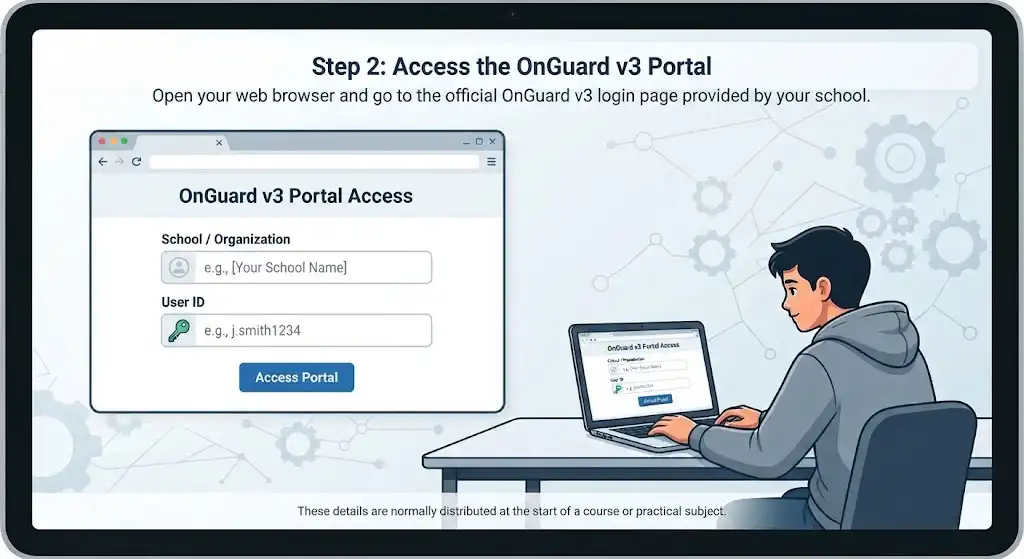
Open your web browser and go to the official onguarf v3 login page provided by your school.
Step 3: Select Your School

Enter your school’s suburb in the search field and choose the correct school from the dropdown list that appears.
Step 4: Sign In Using School Credentials
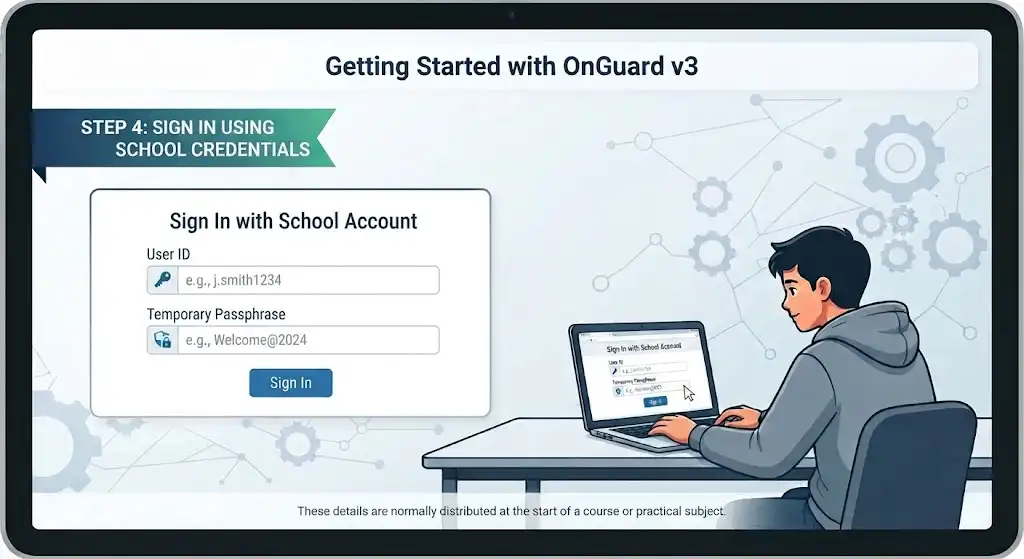
Enter the User ID and temporary passphrase supplied by your teacher or school administrator.
Carefully check for typing mistakes before proceeding.
Step 5: Complete First-Time Account Setup
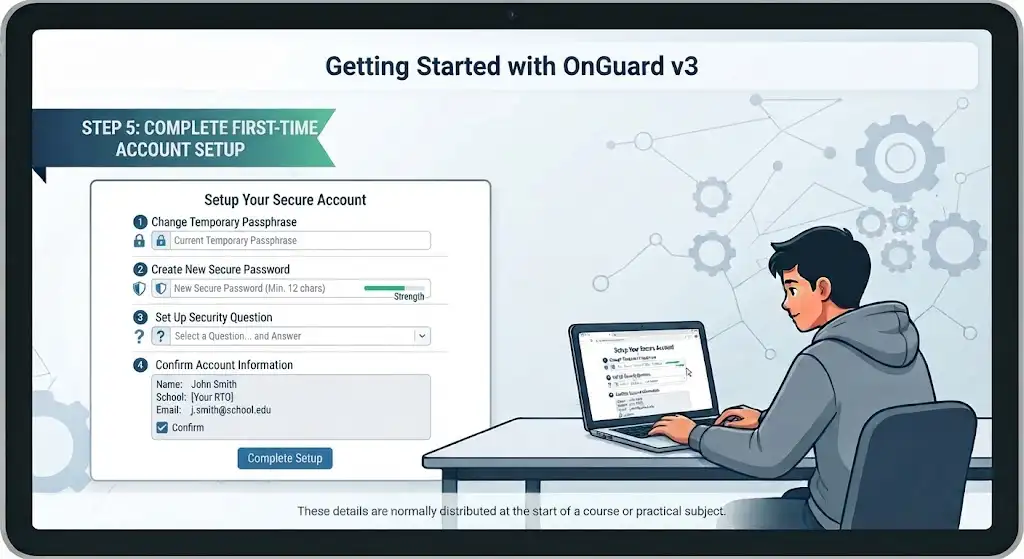
After signing in for the first time, you may be asked to:
Step 6: Access Your Dashboard
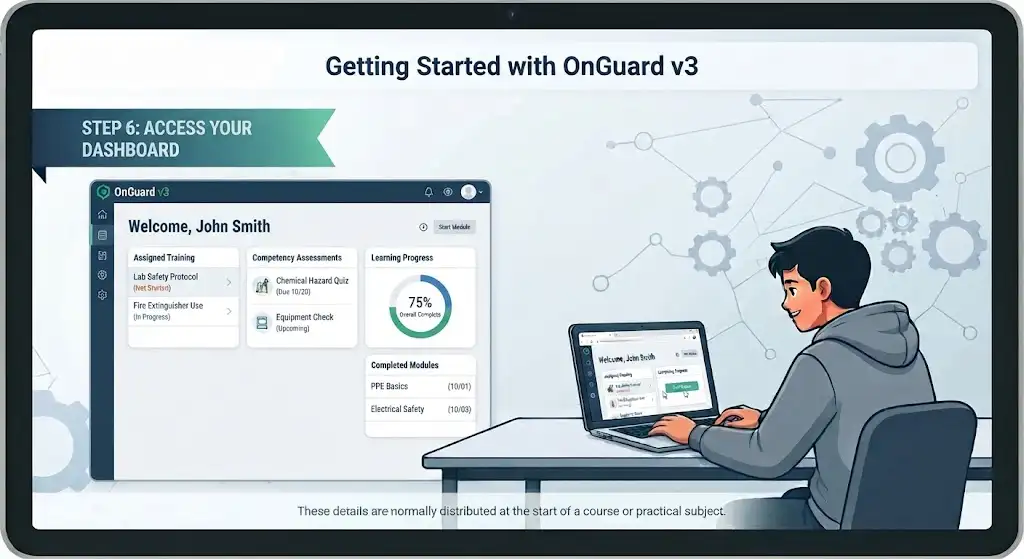
Once setup is complete, you will be taken to your onguarf v3 dashboard where you can:
How OnGuard v3 Training Modules Work
OnGuard v3 is designed to deliver safety education in an organised digital format.
Training modules introduce students to safety information that may be relevant to workshops, laboratories, machinery, equipment, and other practical learning environments. Students should work through the material carefully so they understand the procedures before attempting the associated assessment.
Reading Safety Instructions
Safety information forms the foundation of each training module, so students should read the instructions rather than simply moving through the screens as quickly as possible.
Depending on the subject, the training material may cover areas such as:
Take time to understand what each instruction means, particularly when it relates to equipment operation or emergency procedures.
Interactive Learning Components
OnGuard v3 training may include interactive content to make safety information easier to understand and remember.
Depending on the module, students may work with:
These components help reinforce the information presented during the training and prepare students for the assessment that follows.
Completing Training at School or Home
Schools may provide dedicated class time for students to work through their onguarf v3 requirements.
Where the school’s setup permits it, students may also be able to return to unfinished modules outside school hours. This can be useful when additional time is needed to review safety information or finish outstanding training.
Students should follow the deadlines and instructions given by their teacher. Completing modules within the required timeframe helps ensure they are ready for practical lessons.
Understanding OnGuard v3 Assessments
After working through the relevant learning material, students may be required to complete an assessment.
These assessments are used to check whether students understand the safety information they have been taught. In practical subjects, demonstrating this understanding can be an important requirement before students are allowed to use certain equipment or take part in specific activities.
Purpose of Safety Assessments
An onguarf v3 assessment is intended to measure understanding rather than simply test whether a student can remember individual facts.
Questions may assess a student’s knowledge of:
A successful result indicates that the student has understood the main safety concepts covered by the relevant training.
Competency-Based Learning
Some schools use onguarf v3 as part of a competency-based approach to safety training.
Under this approach, students need to demonstrate an appropriate level of understanding before moving on to practical activities. Safety training therefore forms part of the preparation for practical work rather than being something that can simply be skipped.
For this reason, students should concentrate on understanding the learning material before attempting an assessment. Rushing through the questions without understanding the training can make the process more difficult.
Tips for Passing Assessments
A careful approach can help students prepare for their assessments. Useful habits include:
The aim should be to understand the safety requirements, not simply to finish the assessment as quickly as possible.
Module Lockouts and Retry Periods
Students may occasionally encounter a temporary lockout when completing an onguarf v3 assessment.
A lockout can occur when too many questions are answered incorrectly within an assessment. The restriction is intended to encourage students to review the relevant training instead of repeatedly submitting guesses.
Why Lockouts Exist
The lockout process encourages students to treat the assessment as a learning activity rather than a guessing exercise.
If several answers are incorrect, returning to the training material gives the student an opportunity to identify the relevant safety information and improve their understanding before attempting the assessment again.
This approach reinforces the importance of knowing the correct safety procedures before participating in practical activities.
What Happens During a Lockout?
When the relevant incorrect-answer limit is reached, access to the assessment may be temporarily restricted.
Students may need to wait for a short cooling-off period before attempting to continue. The exact settings can depend on how the school has configured the platform, although temporary restrictions may commonly last only a few minutes.
Rather than repeatedly trying to access the assessment, use the waiting period to review the training material and identify areas that may have caused confusion.
Best Way to Avoid Lockouts
The most effective way to reduce the chance of a lockout is to prepare before starting the assessment.
Students can help themselves by:
Taking a little extra time to understand the material can prevent unnecessary retries and help students complete their required training with greater confidence.
Core Features of OnGuard v3
OnGuard v3 includes a range of tools that help schools deliver safety training efficiently while ensuring students understand the requirements associated with practical learning activities.
The platform combines education, assessment, compliance tracking, and reporting into a single digital environment that supports both students and teachers.
Interactive Safety Modules
Interactive safety modules are among the most important components of onguarf v3.
These modules provide structured learning content covering topics such as:
Students must review the information carefully before progressing to competency assessments.
Progress Tracking System
The progress tracking feature automatically records student activity throughout the learning process.
Teachers can quickly determine:
This reduces administrative workload and helps schools maintain accurate safety records.
Mobile and QR Accessibility
Many schools appreciate the flexibility provided by mobile-compatible access.
Depending on school implementation, students may be able to access assigned training through:
This flexibility helps students continue their learning even when they are away from the classroom.
Digital Proficiency Assessments
The assessment system records competency results electronically.
Once students successfully complete required assessments, teachers can verify that training obligations have been satisfied before allowing participation in practical activities involving equipment or machinery.
Benefits of OnGuard v3 for Students
Students gain several advantages from using onguarf v3.
Better Understanding of Safety Requirements
The platform introduces important safety concepts before students enter practical learning environments.
This preparation helps students understand their responsibilities and encourages safer behaviour during workshop activities.
Flexible Learning Experience
Students can often work through modules at a pace that suits their learning style.
Where permitted by their school, unfinished training can usually be completed outside normal classroom sessions.
Easy Access to Assigned Training
Instead of managing multiple paper documents, students can access training materials from a single platform.
This centralised approach makes it easier to locate assigned modules and monitor progress.
Increased Confidence During Practical Lessons
Students who complete their safety training thoroughly often feel more confident when participating in practical activities because they understand the procedures and expectations beforehand.
Benefits of OnGuard v3 for Teachers and Schools
Educational institutions also benefit significantly from the platform.
Simplified Compliance Management
Schools must demonstrate that students receive appropriate safety instruction before engaging in certain practical activities.
OnGuard v3 helps support this requirement by maintaining digital records of completed training and assessment outcomes.
Reduced Administrative Burden
Manual record keeping can be time-consuming.
By automating training records and assessment tracking, the platform allows teachers to focus more on teaching and less on paperwork.
Improved Monitoring Capabilities
Teachers can quickly identify students who:
This visibility supports more effective classroom management.
Common OnGuard v3 Problems and Solutions
Like any online platform, users may occasionally experience issues while accessing onguarf v3.
Fortunately, most problems can be resolved quickly.
Forgotten Passphrase
One of the most common issues involves forgotten login credentials.
If a student cannot remember their passphrase, they should:
Schools may have different procedures for password recovery, so students should follow local instructions.
Unable to Find Your School
Occasionally students cannot locate their school during the login process.
If this occurs:
A simple spelling mistake is often the cause of search-related issues.
Assessment Lockouts
Students may occasionally trigger a temporary assessment lockout after exceeding the permitted number of incorrect answers.
When this happens:
The lockout period is intended to encourage learning rather than penalise students.
Login Problems
If login attempts continue to fail, students should check:
If the issue remains unresolved, contacting school support staff is usually the best option.
Best Practices for Using OnGuard v3
Following good study habits can help students achieve better results.
Read Every Module Carefully
Safety information should never be rushed.
Understanding the content is far more important than finishing quickly.
Focus on Understanding Rather Than Memorisation
Students who genuinely understand safety concepts generally perform better during assessments and practical activities.
Complete Modules Before Deadlines
Leaving training until the last minute can create unnecessary stress.
Completing modules early provides time to review information and address any technical issues.
Keep Login Details Secure
Students should never share account credentials with others.
Protecting login information helps maintain the integrity of training records.
Ask Questions When Unsure
If any safety concept seems unclear, students should seek clarification from their teacher before completing assessments.
Tips for Success on OnGuard v3
Students who consistently achieve strong assessment results often follow similar habits.
A useful approach includes:
Small improvements in preparation can often make a significant difference in assessment performance.
Frequently Asked Questions About OnGuard v3
Final Thoughts
OnGuard v3 has become an important safety training platform within many Australian schools. By combining digital learning, competency assessments, progress tracking, and compliance management, the system helps prepare students for practical learning environments where safety knowledge is essential.
Students who take the time to read each module carefully, understand the safety requirements, and approach assessments thoughtfully are more likely to succeed. Whether learning about workshop equipment, machinery operation, laboratory procedures, or fire safety, onguarf v3 provides a structured pathway for building knowledge and demonstrating competency before practical activities begin.
For schools, teachers, and students alike, the platform supports a safer and more organised approach to Work Health and Safety education.
READ MORE:
OneSchool Queensland (2026): Student Access, Parent Services and School Information
Goodstart Intranet 2026: Staff Login, Employee Tools & Services
CSU Student Portal (2026): Complete Guide to Login, Study Tools, Records & Support